Tell us about the job
Takes about a minute. No obligation.
A boiler repair call in Schoharie County starts with the burner and the ignition system, because those are the parts that cycle every time the boiler fires. Homes in Schoharie County, NY run heat about nine months a year, from September through May. By late spring, the igniter, the flame sensor, and the heat exchanger have logged a full season of thermal stress. A contractor diagnosing a fault here checks those components before moving to controls or piping, because wear on the firing components accounts for most of what actually fails after a long heating season.
Boilers in housing this old have often outlasted the supply chain built around them. Half the homes in Schoharie County, New York were built in 1974 or earlier (2020-2024 ACS 5-year). A contractor who opens a unit here may find that the part a system of this vintage takes has been discontinued, reengineered, or replaced by something that does not seat cleanly in the original configuration. That gap between what the boiler needs and what a distributor can ship is what sets the scope of the repair, and sometimes what ends it.
The Parts of a Boiler a Contractor Checks First
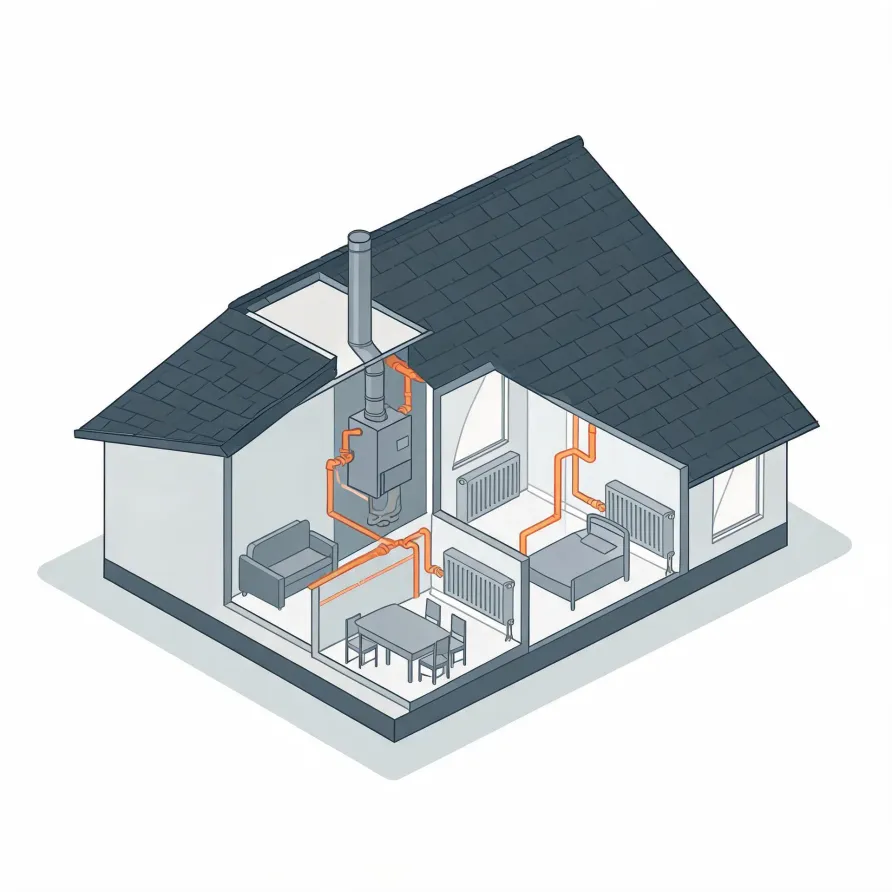
The boiler itself sits in the basement or a mechanical room and is the piece a contractor goes to first. It heats water and sends it through the system. When a home loses heat or sees pressure swings, the burner assembly, heat exchanger, or pressure relief valve inside the boiler are where the diagnosis starts.
From the boiler, pipes carry hot water to radiators or baseboard units throughout the house, and each of those terminal units is a potential fault point if a room runs cold. The circulator pump, which moves water through those pipes, and the expansion tank, which manages pressure, sit close to the boiler and are checked alongside it.
The drawing shows a general layout of the system, and a licensed contractor determines what applies to the specific equipment and configuration in your home.
Get matched in Schoharie CountySchoharie County, by the numbers
167 severe weather events were recorded in Schoharie County, New York between 2015 and 2024.
NOAA National Centers for Environmental Information, Storm Events Database, bulk CSV export, events 2015-01-01 through 2024-12-31.Half the homes in Schoharie County, New York were built in 1974 or earlier (2020-2024 ACS 5-year).
U.S. Census Bureau, 2020-2024 American Community Survey 5-Year EstimatesSchoharie County, New York holds 16,562 housing units (2020-2024 ACS 5-year).
U.S. Census Bureau, 2020-2024 American Community Survey 5-Year EstimatesOwners occupy 76.4% of the occupied homes in Schoharie County, New York (2020-2024 ACS 5-year).
U.S. Census Bureau, 2020-2024 American Community Survey 5-Year EstimatesSevere Weather Events in Schoharie County
Boilers work harder and fail faster when the weather outside swings hard. How much stress the local climate puts on heating equipment is a Schoharie County question, and that shapes the repair picture here.
167 severe weather events, 2015–2024. Source: NOAA National Centers for Environmental Information, Storm Events Database.