Tell us about the job
Takes about a minute. No obligation.
A boiler repair call in Chautauqua County starts with a contractor who knows the equipment has been working, not sitting. Homes in Chautauqua County, NY run heat about eight months a year, from October through May. The burner, heat exchanger, and ignition system cycle through that entire period, and the wear on them reflects it. Corrosion, cracked seals, and ignition failures are not random here; they trace directly to accumulated runtime on parts that never had an extended rest. A contractor pricing a repair accounts for that load before deciding which components to replace and which to leave.
Cast-iron boiler sections, decades of mineral buildup in the distribution lines, and flue connections that have expanded and contracted through a great many winters are what a contractor opens up to in a house like this. Half the homes in Chautauqua County, New York were built in 1953 or earlier (2020-2024 ACS 5-year). That history shows up inside the equipment: sediment in the system, degraded gaskets, and burner assemblies whose replacement parts require sourcing rather than pulling off a shelf. What the contractor finds when the jacket comes off sets the repair scope, and in stock like this, what is inside the unit is where the real variables live.
The Parts of a Boiler a Contractor Checks First
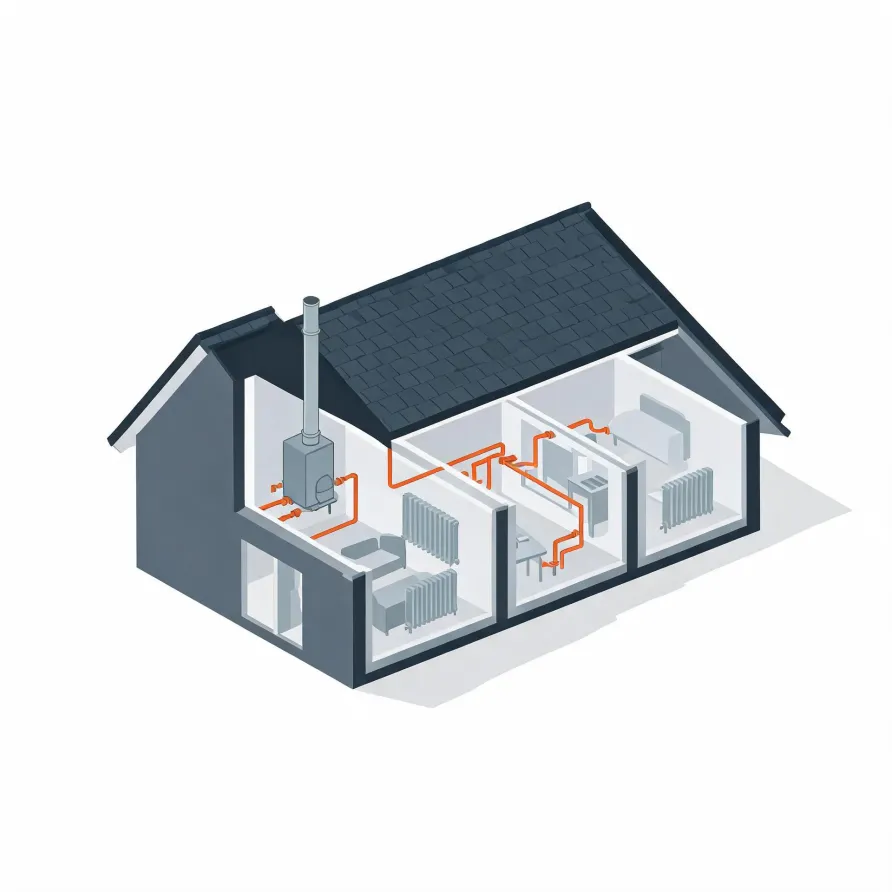
The boiler itself sits in the basement or mechanical room and is the piece a contractor reaches first. It houses the burner, the heat exchanger, and the controls that govern how the unit fires. When heat stops arriving or the system cycles strangely, any one of those internal components can be the source.
The circulator pump moves heated water out through the supply pipes and pulls cooler water back through the return. The expansion tank, usually mounted nearby, absorbs pressure as water heats and keeps the system from spiking. The pressure relief valve and the thermostat are smaller pieces, but both draw close attention when a complaint points toward pressure or uneven heat.
The drawing shows a typical boiler layout, and a licensed contractor determines which components apply to the specific system in your home.
Get matched in Chautauqua CountyChautauqua County, by the numbers
300 severe weather events were recorded in Chautauqua County, New York between 2015 and 2024.
NOAA National Centers for Environmental Information, Storm Events Database, bulk CSV export, events 2015-01-01 through 2024-12-31.Half the homes in Chautauqua County, New York were built in 1953 or earlier (2020-2024 ACS 5-year).
U.S. Census Bureau, 2020-2024 American Community Survey 5-Year EstimatesChautauqua County, New York holds 66,476 housing units (2020-2024 ACS 5-year).
U.S. Census Bureau, 2020-2024 American Community Survey 5-Year EstimatesOwners occupy 68.9% of the occupied homes in Chautauqua County, New York (2020-2024 ACS 5-year).
U.S. Census Bureau, 2020-2024 American Community Survey 5-Year EstimatesSevere Weather Events in Chautauqua County
Extreme weather puts real strain on boiler systems, and the pattern of storms in a given area shapes how hard that equipment has to work over its lifetime. Repair needs in Chautauqua County reflect local conditions, not averages drawn from somewhere else.
300 severe weather events, 2015–2024. Source: NOAA National Centers for Environmental Information, Storm Events Database.