Tell us about the job
Takes about a minute. No obligation.
A boiler repair call in Columbia County starts with the burner assembly and heat exchanger, because those are the parts that have been cycling hard since October. Homes in Columbia County, NY run heat about eight months a year, from October through May. By the time May arrives, the ignition system has fired hundreds of times, and fatigue in the heat exchanger shows up as cracks or flue-gas leaks that a contractor can pressure-test and inspect directly. Sediment in the sections and corrosion at the relief valve follow from the same sustained runtime. A contractor working a repair here prices those items first, not last.
Piping runs and zone controls in a house tell a contractor more about what the repair actually involves than the boiler nameplate does. Half the homes in Columbia County, New York were built in 1966 or earlier (2020-2024 ACS 5-year). A unit sitting in housing that old is almost certainly the second or third piece of equipment to occupy that mechanical room, and the distribution system around it was laid out for something else. When a contractor opens a boiler here and traces the problem outward, what they find in the piping, the zone valves, and the controls shapes both the parts list and the scope of the fix.
The Parts of a Boiler a Contractor Checks First
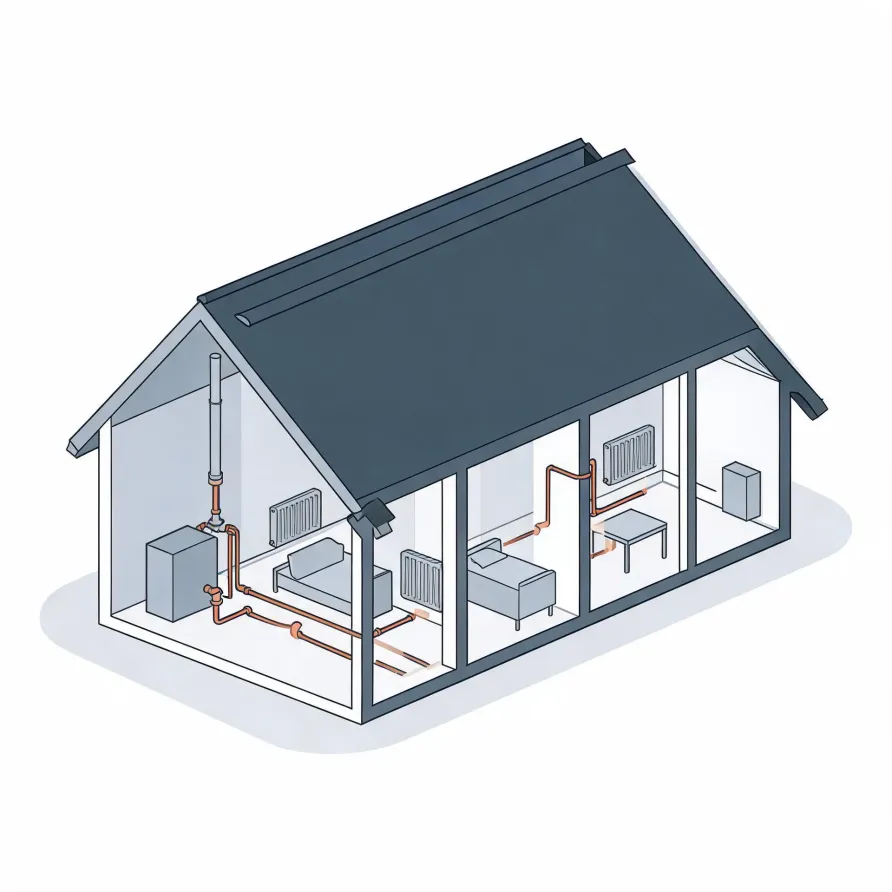
The boiler itself sits in the basement or a utility room and is the piece a contractor goes to first. It heats water and sends it out through the system. When a boiler is short-cycling, losing pressure, or failing to heat at all, the problem usually starts here, at the heat exchanger, the burner, or the pressure relief valve.
From the boiler, pipes carry hot water to radiators or baseboard units throughout the house, then return the cooled water to start again. The circulator pump drives that loop, and the expansion tank keeps pressure from building past safe levels. A contractor checks these along with the thermostat, which tells the whole system when to fire.
The drawing shows the general layout of a boiler system, and a licensed contractor determines which parts apply to your particular home.
Get matched in Columbia CountyColumbia County, by the numbers
438 severe weather events were recorded in Columbia County, New York between 2015 and 2024.
NOAA National Centers for Environmental Information, Storm Events Database, bulk CSV export, events 2015-01-01 through 2024-12-31.Half the homes in Columbia County, New York were built in 1966 or earlier (2020-2024 ACS 5-year).
U.S. Census Bureau, 2020-2024 American Community Survey 5-Year EstimatesColumbia County, New York holds 33,393 housing units (2020-2024 ACS 5-year).
U.S. Census Bureau, 2020-2024 American Community Survey 5-Year EstimatesOwners occupy 76.3% of the occupied homes in Columbia County, New York (2020-2024 ACS 5-year).
U.S. Census Bureau, 2020-2024 American Community Survey 5-Year EstimatesSevere Weather Events in Columbia County
Boilers work hardest when outdoor conditions push hardest against them. How often that happens in Columbia County shapes how much stress local equipment carries and how often repair needs arise.
438 severe weather events, 2015–2024. Source: NOAA National Centers for Environmental Information, Storm Events Database.