Tell us about the job
Takes about a minute. No obligation.
A boiler repair in Queens starts with what the burner and ignition system have been doing. Homes in Queens County, NY run heat about seven months a year, from October through April. Across that stretch, the burner fires and the ignition system cycles repeatedly, and those are the components a contractor checks first when something fails. Heat exchangers crack from thermal stress that builds over repeated cycles. A system that was undersized at install shows that damage sooner, because it runs harder to meet demand and gets less idle time to cool between calls.
Prewar boiler houses in Queens often carry piping and distribution hardware that has been adapted across multiple heating generations, and what a contractor finds once the boiler is open tends to point straight back into that surrounding infrastructure. Half the homes in Queens County, New York were built in 1953 or earlier (2020-2024 ACS 5-year). That means a repair diagnosis here does not stop at the boiler itself. The surrounding steam or hot-water lines, the valves, the vents, and the bleeders have all aged alongside it, and a part that looked like the answer can turn out to be downstream of something older that was the actual problem.
The Parts of a Boiler a Contractor Checks First
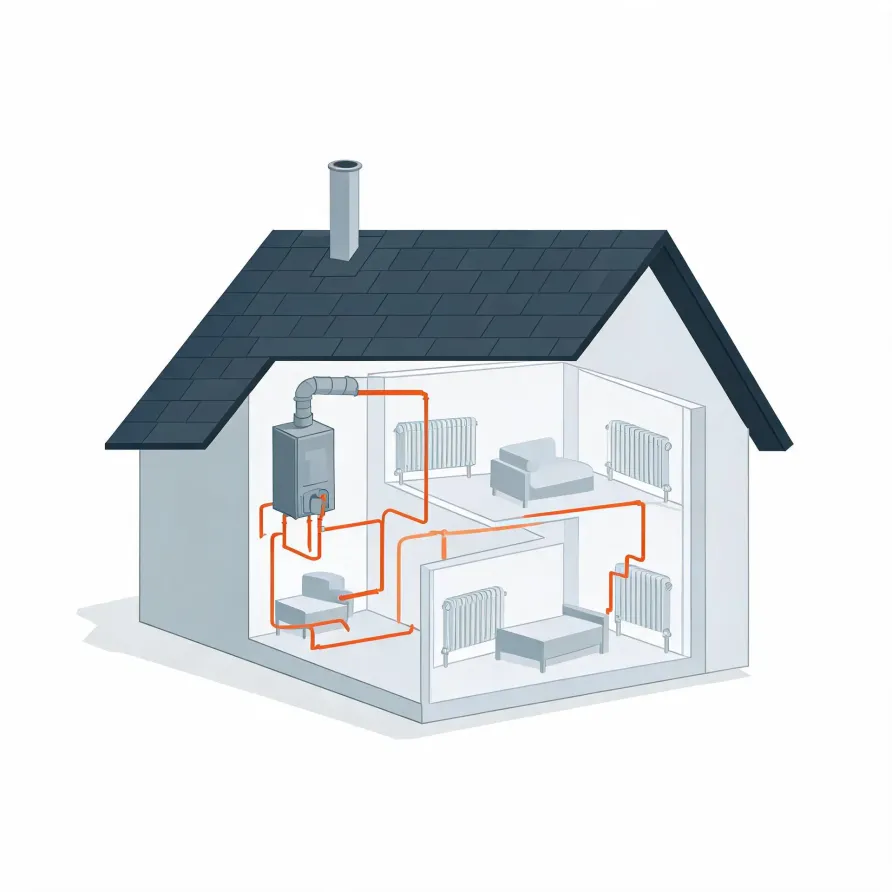
The boiler itself sits in the basement or a mechanical room and is the piece a contractor goes to first. It heats water and pushes it through the system. When pressure drops, the unit short-cycles, or heat stops reaching certain rooms, the boiler's internal components, including the heat exchanger, burner, and pressure relief valve, are where the diagnosis starts.
From the boiler, pipes carry hot water to radiators or baseboards positioned throughout the living spaces, and each of those terminal units has its own valves and fittings that can fail or restrict flow. The circulator pump, which moves water through those pipes, sits close to the boiler and is a frequent point of failure when circulation is uneven.
The drawing shows a general layout of these components, and a licensed contractor determines which parts apply and what condition they are in for your specific home.
Get matched in Queens CountyQueens County, by the numbers
161 severe weather events were recorded in Queens County, New York between 2015 and 2024.
NOAA National Centers for Environmental Information, Storm Events Database, bulk CSV export, events 2015-01-01 through 2024-12-31.Half the homes in Queens County, New York were built in 1953 or earlier (2020-2024 ACS 5-year).
U.S. Census Bureau, 2020-2024 American Community Survey 5-Year EstimatesQueens County, New York holds 910,206 housing units (2020-2024 ACS 5-year).
U.S. Census Bureau, 2020-2024 American Community Survey 5-Year EstimatesOwners occupy 44.9% of the occupied homes in Queens County, New York (2020-2024 ACS 5-year).
U.S. Census Bureau, 2020-2024 American Community Survey 5-Year EstimatesSevere Weather Events in Queens County
Boilers carry a heavier load when outdoor conditions push hard against a building's envelope. How often that happens in Queens shapes how hard the equipment works and how quickly wear accumulates.
161 severe weather events, 2015–2024. Source: NOAA National Centers for Environmental Information, Storm Events Database.