Tell us about the job
Takes about a minute. No obligation.
A boiler repair in Niagara County starts with what the burner and ignition system have already been through. Homes in Niagara County, NY run heat about eight months a year, from October through May. That kind of sustained cycling loads the heat exchanger and the ignition components harder than anything else in the system, and those are the parts a contractor checks first. Corrosion on the heat exchanger, worn igniter assemblies, and fatigued seals at the burner head are the findings that drive the repair scope here.
Boiler systems work through the distribution they feed, and in Niagara County that distribution is often as old as the house itself. Half the homes in Niagara County, New York were built in 1958 or earlier (2020-2024 ACS 5-year). Piping runs, radiators, and zone configurations put in for equipment that is long gone set the physical boundary of what any repair can accomplish. A contractor opening a boiler here has to account for what the rest of the system will accept, not just what the unit itself needs. A failed zone valve or a cracked section tells one story; the piping it connects to tells another, and both determine the scope of the repair.
The Parts of a Boiler a Contractor Checks First
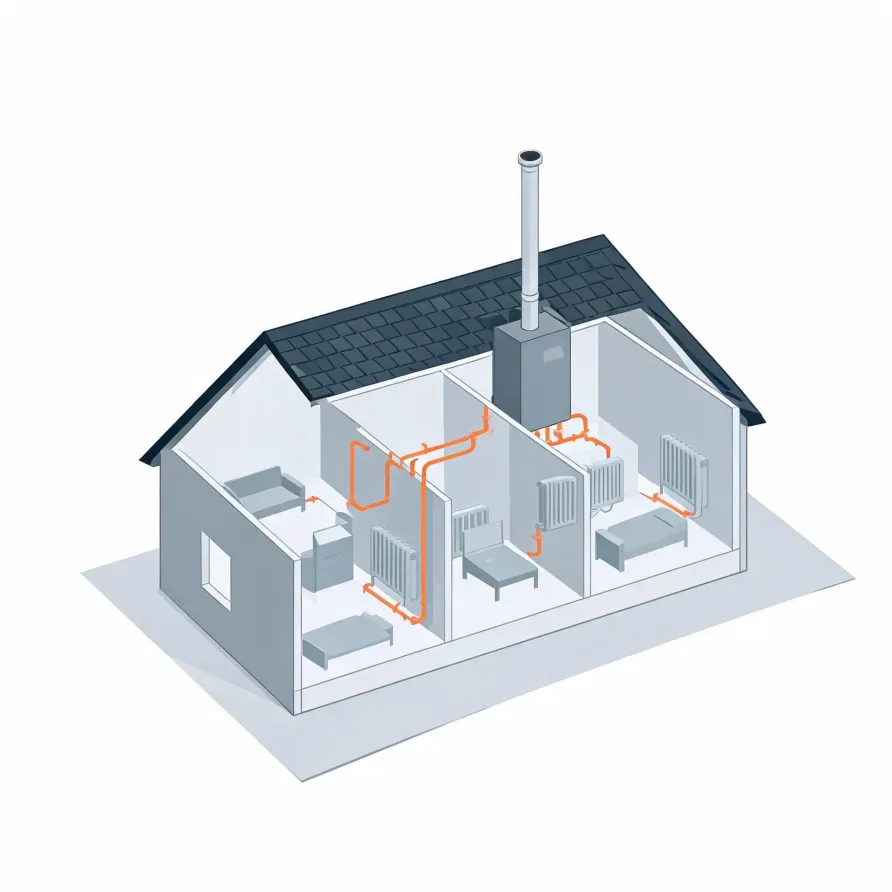
The boiler itself sits in the basement or mechanical room and is the piece a contractor goes to first. It heats water and pushes it through the system. When it fails, the signs show up as no heat, uneven heat, or the unit cycling on and off without completing a run. The burner, heat exchanger, and controls inside the boiler are the usual starting points.
Radiators or baseboard units sit in the living spaces and release heat into the rooms. The circulator pump, which moves hot water through the pipes, and the expansion tank, which manages pressure, both sit near the boiler. A failed pump means rooms go cold even when the boiler fires. A waterlogged expansion tank throws pressure readings off and can trigger the pressure relief valve.
The drawing shows the general layout of a boiler system, and a licensed contractor determines which components apply to your specific setup.
Get matched in Niagara CountyNiagara County, by the numbers
121 severe weather events were recorded in Niagara County, New York between 2015 and 2024.
NOAA National Centers for Environmental Information, Storm Events Database, bulk CSV export, events 2015-01-01 through 2024-12-31.Half the homes in Niagara County, New York were built in 1958 or earlier (2020-2024 ACS 5-year).
U.S. Census Bureau, 2020-2024 American Community Survey 5-Year EstimatesNiagara County, New York holds 100,446 housing units (2020-2024 ACS 5-year).
U.S. Census Bureau, 2020-2024 American Community Survey 5-Year EstimatesOwners occupy 71.2% of the occupied homes in Niagara County, New York (2020-2024 ACS 5-year).
U.S. Census Bureau, 2020-2024 American Community Survey 5-Year EstimatesSevere Weather Events in Niagara County
Boilers work hardest when outdoor conditions are most demanding, and that workload is shaped by what this area's weather actually does year over year. Repair needs in Niagara County track with local conditions, which is why the pattern here matters more than any regional average.
121 severe weather events, 2015–2024. Source: NOAA National Centers for Environmental Information, Storm Events Database.