Tell us about the job
Takes about a minute. No obligation.
Sizing a boiler for a Sullivan County house is not a guess a contractor patches later. Homes in Sullivan County, NY run heat about nine months a year, from September through May. The burner and heat exchanger carry that load every year, cycling on and off through a long stretch of cold months, and a unit that is even slightly undersized runs longer per cycle to keep up. That extra runtime accumulates on the ignition system and the heat exchanger seams first. A contractor quoting a replacement here calculates the actual heat loss of the house before settling on a model, because getting the output wrong in either direction shortens what the new unit delivers.
Ductwork laid down for an earlier generation of heating equipment does not automatically carry what a modern boiler needs, and in Sullivan County the gap between what a house was built for and what a contractor is now being asked to install is wide enough to shape the whole job. Half the homes in Sullivan County, New York were built in 1974 or earlier (2020-2024 ACS 5-year). That means the plumbing runs, the flue routing, and the distribution layout a contractor finds are built around something other than what is going in now. A boiler quote here prices the house as much as it prices the unit.
What a Boiler Installation Puts in Your Home
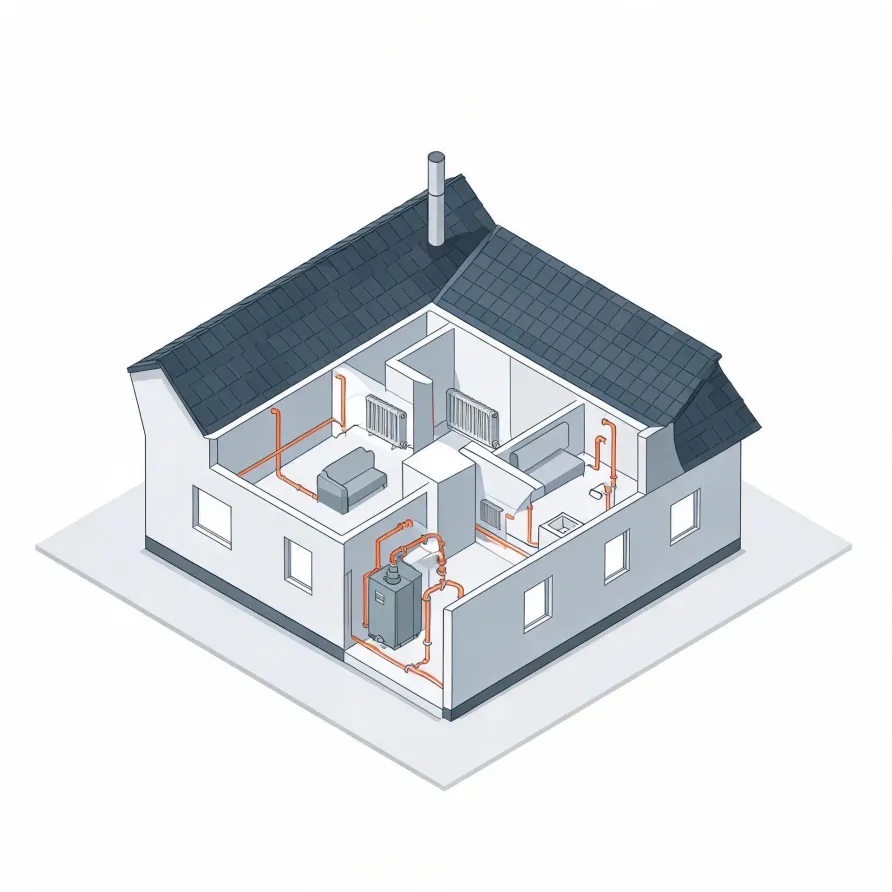
The boiler itself sits in the basement or a mechanical room and is the heart of the system. It heats water and sends it out through supply pipes to wherever heat is needed. A contractor also installs the expansion tank nearby, which absorbs pressure changes as the water heats and cools.
Radiators or baseboard units go in each room and release that heat into the living space. The circulator pump, mounted close to the boiler, keeps the water moving through the loop. A new installation also includes the flue connection, which carries combustion gases out through the wall or chimney.
The drawing shows a typical layout, and a licensed contractor determines exactly which components apply to your home and how they are configured.
Get matched in Sullivan CountySullivan County, by the numbers
185 severe weather events were recorded in Sullivan County, New York between 2015 and 2024.
NOAA National Centers for Environmental Information, Storm Events Database, bulk CSV export, events 2015-01-01 through 2024-12-31.Half the homes in Sullivan County, New York were built in 1974 or earlier (2020-2024 ACS 5-year).
U.S. Census Bureau, 2020-2024 American Community Survey 5-Year EstimatesSullivan County, New York holds 49,994 housing units (2020-2024 ACS 5-year).
U.S. Census Bureau, 2020-2024 American Community Survey 5-Year EstimatesOwners occupy 67.4% of the occupied homes in Sullivan County, New York (2020-2024 ACS 5-year).
U.S. Census Bureau, 2020-2024 American Community Survey 5-Year EstimatesSevere Weather Events in Sullivan County
Boilers work hardest when outside conditions are extreme, and how hard a system has to work shapes what size and grade of equipment belongs in a given home. Sullivan County's weather record is part of that calculation.
185 severe weather events, 2015–2024. Source: NOAA National Centers for Environmental Information, Storm Events Database.